
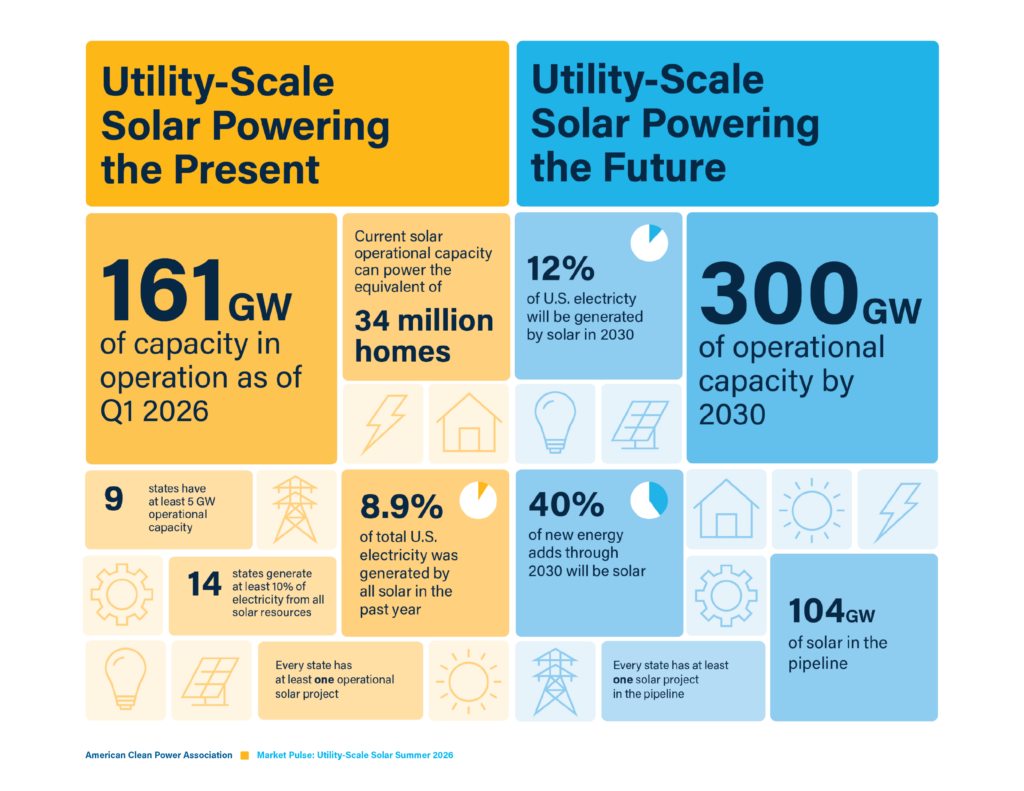

In an era of rising energy demand, a diverse, reliable energy mix is essential for keeping the lights on across America. Utility-scale solar has been a driving force in the expansion of new resources to strengthen our nation’s grid and deliver enough energy to power at least 34 million American homes.
ACP’s newly released Market Pulse: Utility-Scale Solar Summer 2026 report dives into the current state of solar: how it’s powering the present, increasing energy capacity for the future, and strengthening the American workforce.
Powering the Present
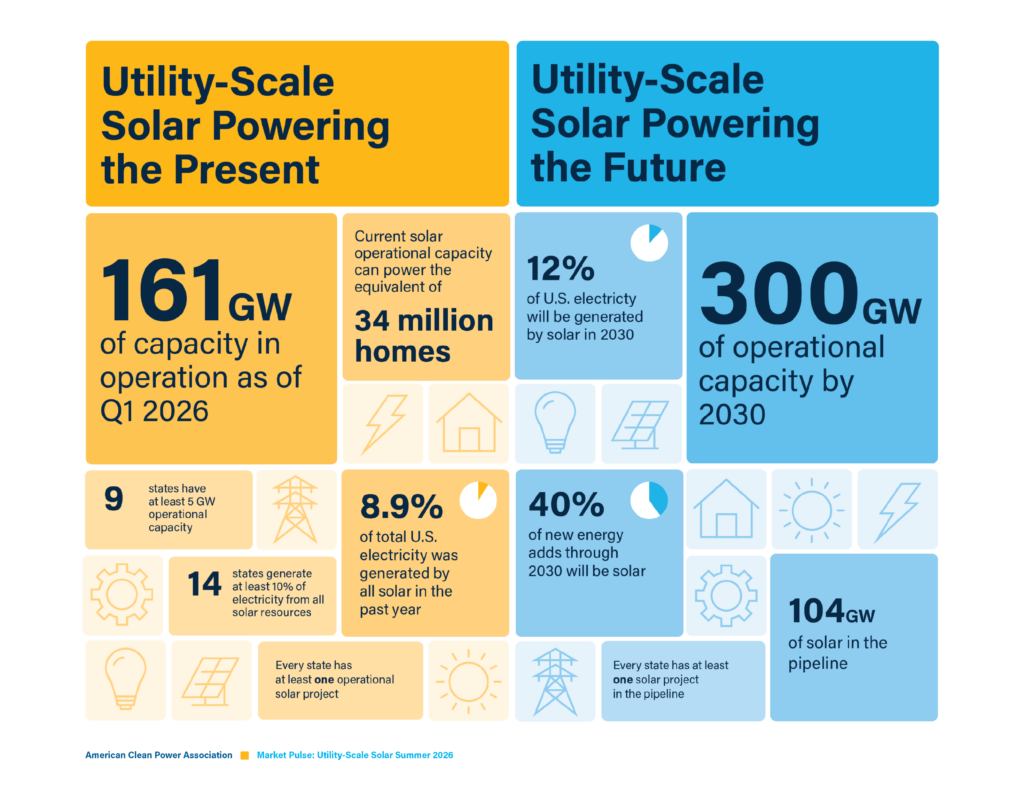
Utility-scale solar has grown at a record-breaking pace in recent years. Since 2020, annual installations have surpassed 10 GW/year, with more than 20 GW added annually since 2023. Cumulative operational capacity for utility-scale solar has more than tripled from 48 GW in 2020 to 161 GW at the end of Q1 2026.
This growth in capacity translates to real increases in electricity delivered to the U.S. grid. Just 10 years ago, solar accounted for less than 1% of total U.S. electricity. As of Q1 2026, utility-scale solar generated 6.8% of total electricity in the U.S. over the past year. When behind-the-meter solar resources are included, solar generated 8.9%.
The rapid growth of solar is a nationwide trend. Forty-one of the 50 U.S. states have at least doubled their operational solar portfolios between 2020 and Q1 2026; and within those states, 20 have grown their solar capacity by more than five times.
No matter how you slice it, solar is instrumental to the power sector’s ability to keep pace with rising energy demand, and solar will continue to be a key part of the story as demand grows.
Powering the Future
ACP’s in-house energy outlook forecasts 300 GW of operational solar capacity in the U.S. by 2030, nearly doubling the current operational portfolio in only five years.
Solar has already outpaced other energy technologies in capacity additions. In 2025, utility-scale solar additions made up nearly 50% of all energy installs, surpassing natural gas, wind, storage, nuclear, coal, and other technologies. Through 2030, ACP’s forecast shows solar accounting for more than 40% of new energy additions, even as gas-fired generation additions accelerate.
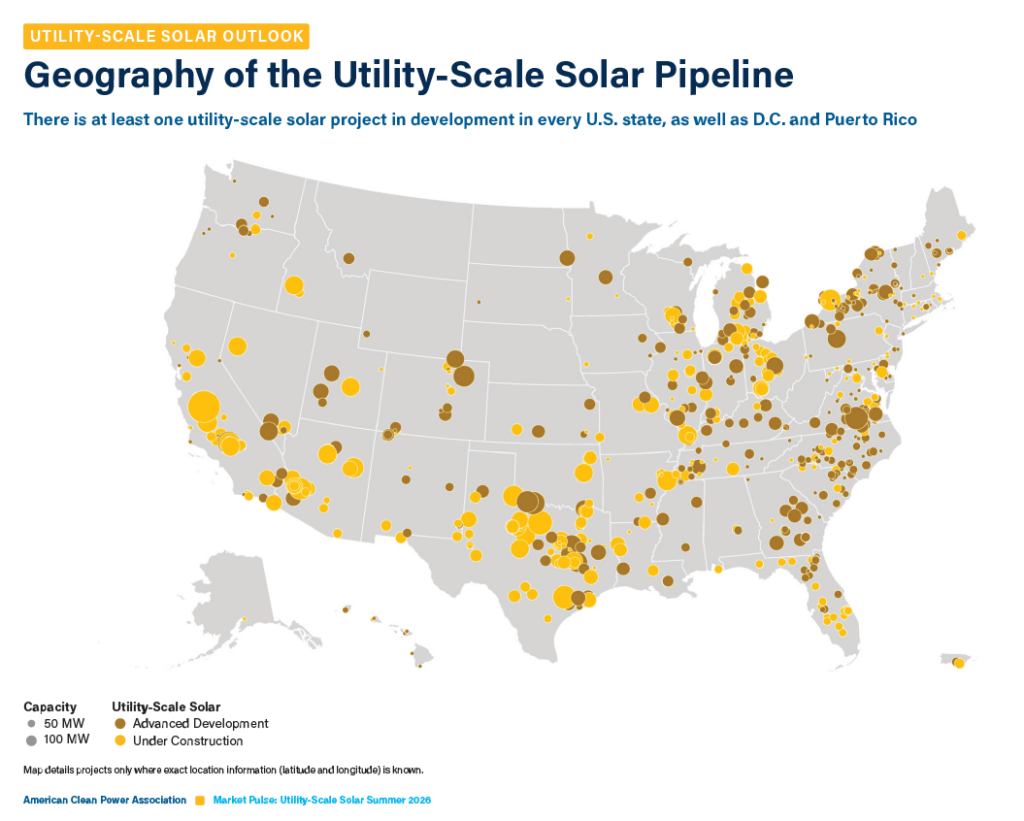
In the near-term, ACP’s research team is tracking 103 GW of capacity in the solar pipeline, which includes projects that are under construction or in advanced development. The solar pipeline exceeded 100 GW for the first time at the end of 2025 and accounts for 53% of the total clean energy pipeline. Although battery storage projects are hitting their own deployment boom, solar will likely continue to be the leading clean energy technology in the near-term.
Powering the American Workforce
The continued strong buildout of solar power capacity not only helps keep the lights on amid growing electricity demand but also bolsters job creation, investment in rural communities, and economic growth.
The solar industry supports 703,000 jobs across direct, indirect, and induced positions. For every one job directly employed in solar, an additional two jobs are supported downstream.
In addition to job creation, solar workers earn a higher average wage than the mean wage of all private industries and government workers, and the solar industry employs U.S. veterans at a higher rate (8%) than the national average (5%). American workers are integral to developing, building, and maintaining solar projects across the nation.
Beyond direct employment in the solar workforce, operational utility-scale solar capacity has also stimulated nearly $350 billion in investment. At the community level, solar projects have contributed over $1.8 billion in state and local taxes and land-lease payments over the past year alone.
Looking ahead, the solar projects in development today are slated to bring even more value and local benefits to communities in every state tomorrow.
To learn more about how solar is delivering power to Americans, check out the first edition of ACP’s Market Pulse: Utility-Scale Solar.
The post Solar by the Numbers: Powering America’s Future appeared first on ACP.