

French consultancy Clean Horizon has published its June Battery Profitability Index, an indicator of potential revenue in European markets for 2-hour battery energy storage systems (BESS). The index considers the market share of batteries in the energy and ancillary services markets (FCR, aFRR, and mFRR), using as a benchmark a battery with 85% efficiency, 1.5 cycles per day, and full availability.
The data shows positive growth in BESS system revenues across several European markets, driven primarily by increased volatility in wholesale markets and by price changes in balancing and reservation services. Significant differences between countries remain, both in terms of optimal battery life and the mix of markets that generate revenue.
Belgium recorded one of its highest revenue levels in recent months. The recovery in solar and wind power generation drove up energy prices and boosted the index revenue to €340,000/MW/year, its highest level since July 2015.
In Germany, revenues remained relatively stable across different battery lifespans, with monthly variations ranging from -4% to +7%. The FCR and aFRR capacity markets maintained average prices above €15/MWh, while the day-ahead market exhibited high volatility, with peak prices exceeding €900/MWh and troughs below -€100/MWh.
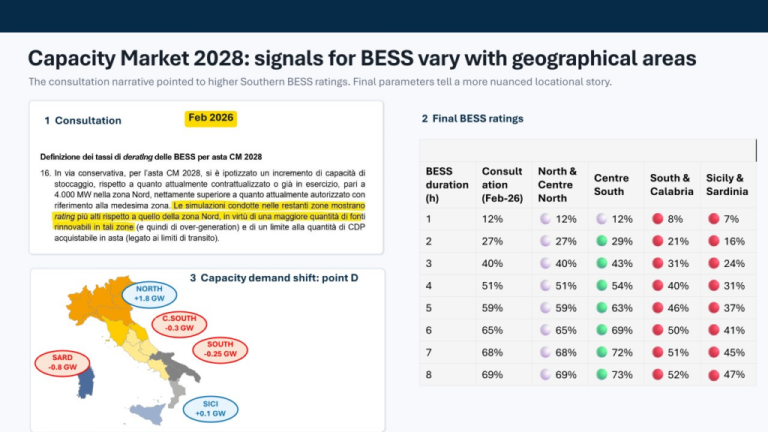
Italy continues to stand out among the most attractive markets. In the SUD region, revenues from a four-hour battery exceeded €500,000/MW/year for the third consecutive month, reaching €592,000/MW/year, primarily due to a higher weighted average price in the intraday market. In the NORD region, revenues reached €422,000/MW/year, distributed mainly between the intraday and mFRR markets.
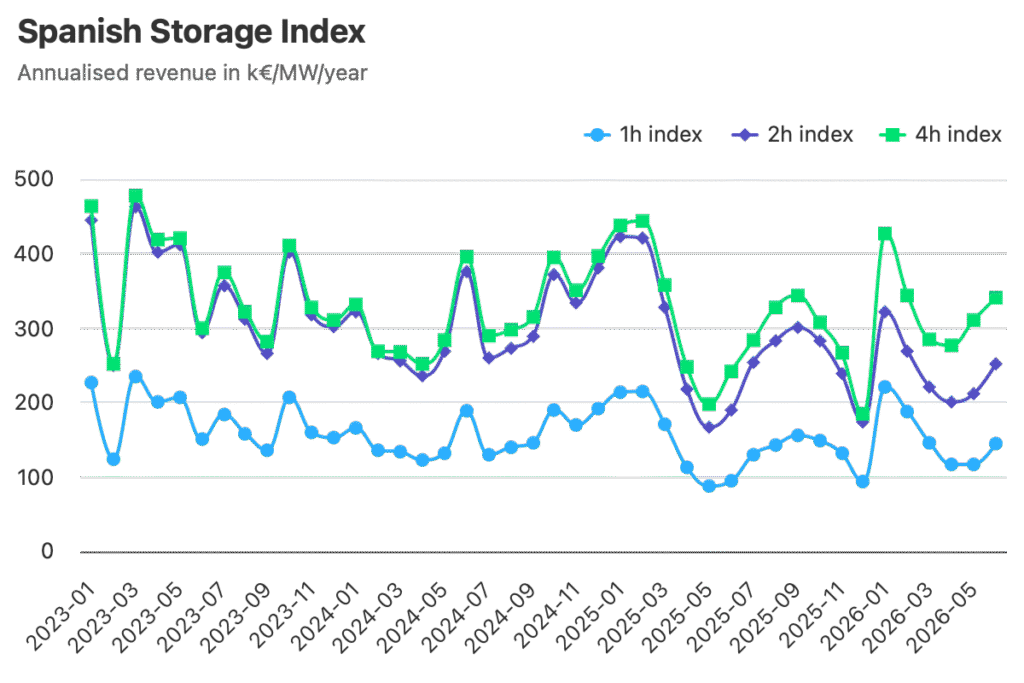
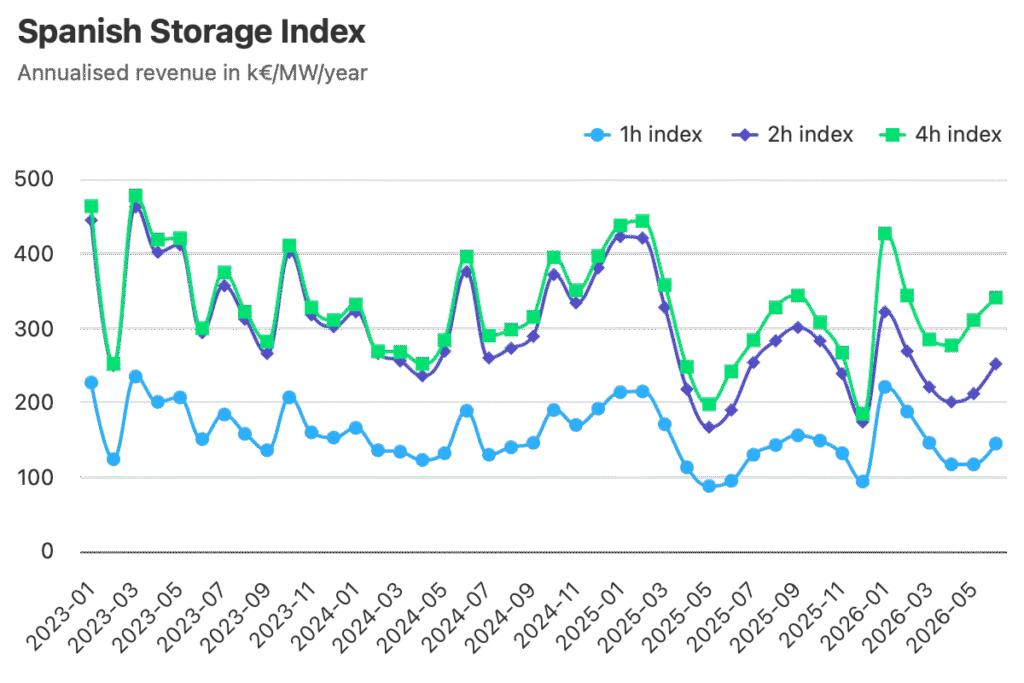
In Spain, revenues for a two-hour battery increased by 18.9% month-on-month to €252,000/MW/year, primarily due to increased revenues from the continuous intraday market, coupled with improved spreads available on aFRR and day-ahead contracts. Portugal, on the other hand, saw slight declines of 3% for two-hour batteries and 4% for four-hour systems, mainly due to lower aFRR reserve prices.
The Baltic markets also experienced strong increases. In Estonia, two-hour index revenues rose 84% compared to May, reaching €322,000/MW/year, with mFRR as the main source of revenue, accounting for 58% of the total. In Latvia and Lithuania, revenues grew by 31% and 32%, respectively, reaching €443,000/MW/year and €431,000/MW/year. In both cases, mFRR and aFRR reserves accounted for the majority of revenues.
Poland, despite registering a 35% correction compared to the previous month, maintained a high level of €529,000/MW/year for a two-hour battery.
Finally, France experienced a 13% drop, while Finland remained virtually stable, with a day-ahead spread of €81/MWh and revenues of €89,000/MW/year for the two-hour index. Sweden also remained stable, at €164,000/MW/year, despite a slight reduction in reserve prices offset by a 10% improvement in the day-ahead spread.
(All prices in Euros, exchange rate to US at €1 = USD $1.15)
From pv magazine Spain.
The post European BESS revenues mostly rise in June, with Italy still a standout appeared first on Energy Storage.