


The latest 3Q 2026 BNEF Australia Power Market Quarterly report shows that average power prices fell between 40% and 65% across the National Electricity Market (NEM) year on year in the second quarter of 2026.
BNEF in the report said the sharp drop in prices and intraday volatility were being driven by higher renewable generation and increased battery discharge during evening peak demand periods. Across the NEM, average intraday arbitrage was $103 (USD 73) per MWh in the second quarter, marking a 79% year-on-year decline driven by a milder winter and lower evening demand.
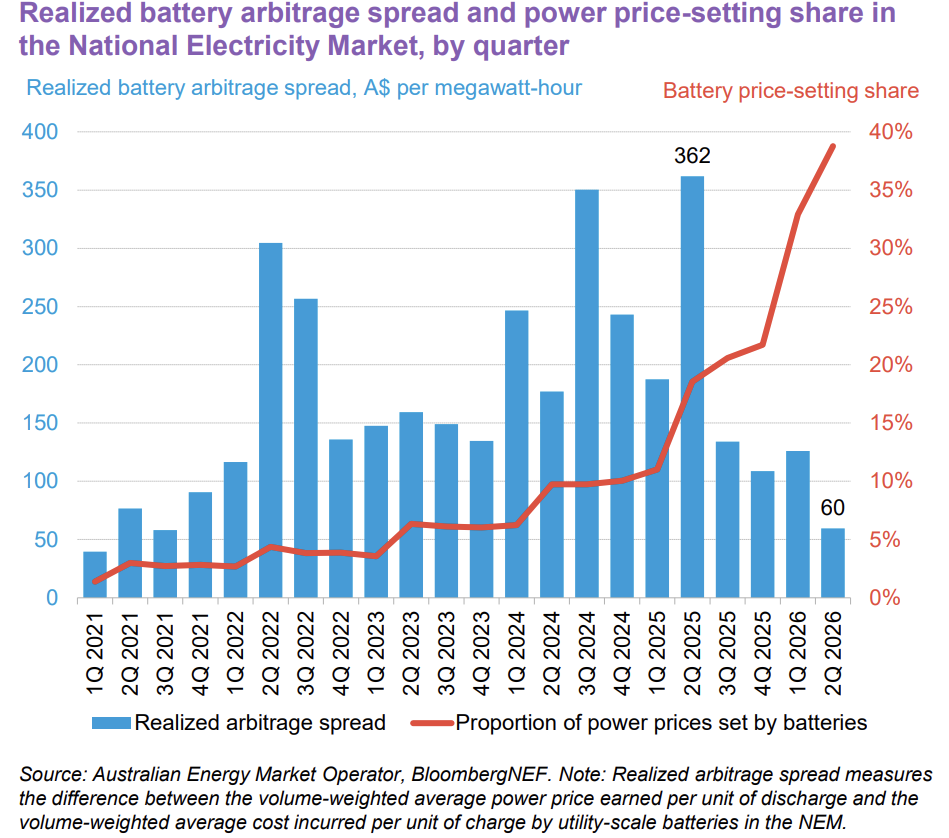
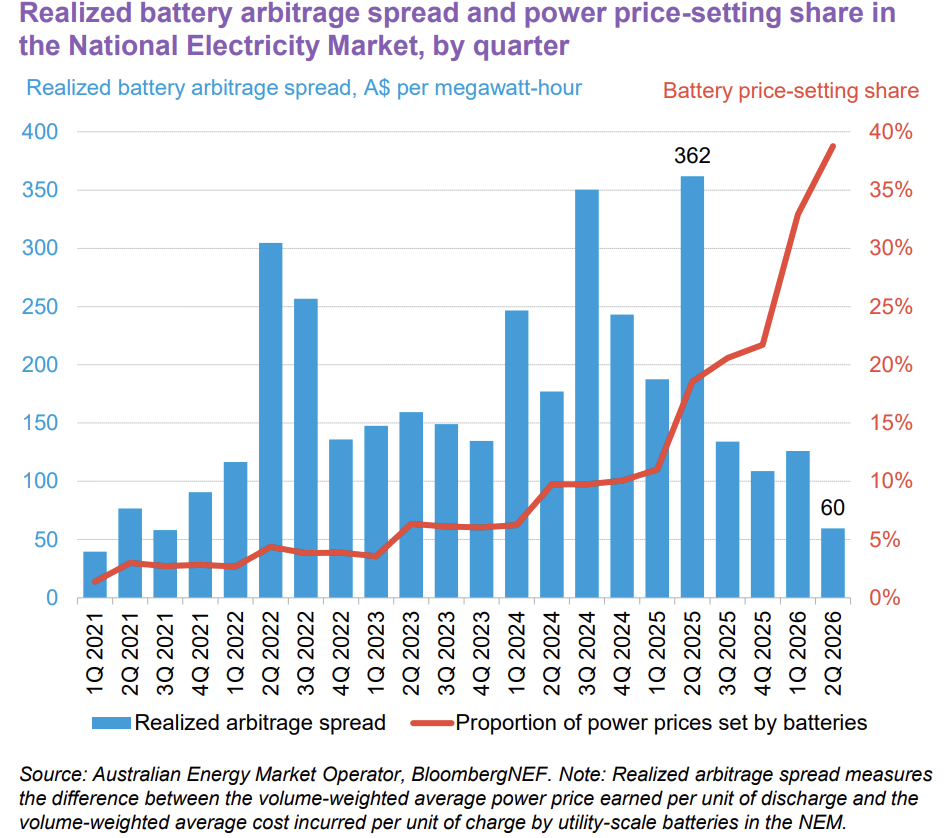
Competition among an expanding fleet of utility-scale batteries further compressed arbitrage returns, which fell 84% from a year earlier to $60/MWh, BNEF said, noting that the decline could signal greater revenue cannibalization as more capacity is commissioned.
BNEF forecasts that as renewable and storage capacity expands, realized prices and battery returns will likely remain under growing pressure. The research firm estimated that utility-scale batteries earned $53 million in arbitrage revenue in the second quarter, a 57% year-on-year decrease. Frequency control ancillary services (FCAS) generated $4.8 million in revenue, down 51% from the previous year, as rapid capacity growth saturated the market.
BNEF noted the Tailem Bend 2 hybrid battery in South Australia, owned by Vena Energy, recorded the highest average market value of FCAS of all batteries in the NEM in 2Q 2026, earning A$27/MWh/day during this period.
The realized data mirrors industry expectations, which has been expecting and is now witnessing changes to revenues from more BESS capacity. While the market in Australia has many years left to mature, the earliest days of easy revenue are in the rearview mirror. James Costello, chief executive officer of EORA Energy, noted this in a column on ESS News, as he advocated for long-duration storage.
When Australian batteries and renewables are playing
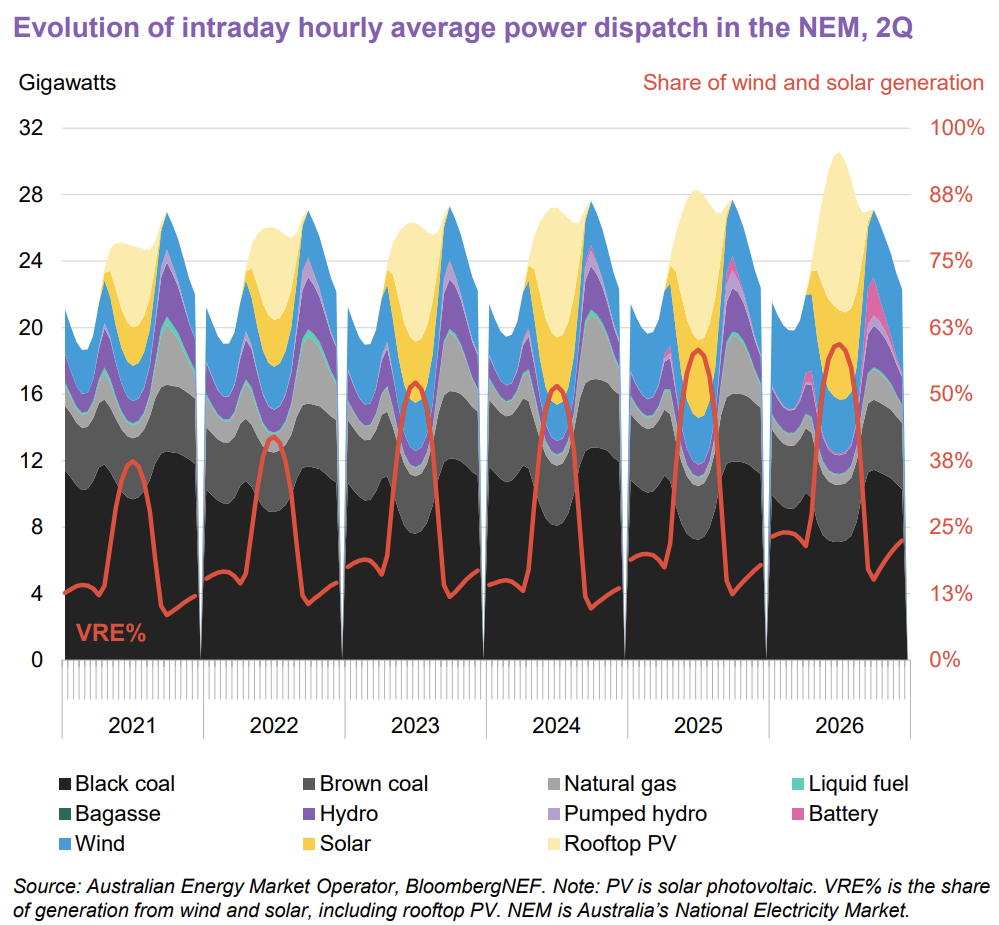
BNEF also said utility-scale batteries have overtaken gas as the market’s primary intraday balancer of variable renewable energy supply. Batteries supplied an average 8.4% of power demand at 6 pm during the quarter, up from 3.1% a year earlier (a 270% increase), while the share of gas dropped to 6.8% from 12.6%.
The growing influence of batteries was reflected in wholesale price formation, with batteries setting wholesale prices in 39% of intervals in the second quarter from 19% a year earlier.
While market volatility declined, renewable energy generation continued to climb. Wind and solar combined supplied 35% of the generation share in Q2 2026, up from 31% year over year.
This influx of renewable energy further displaced coal, gas, and liquid fuel generation.
The post BNEF report details heavy falls in battery revenue in Australia appeared first on Energy Storage.