

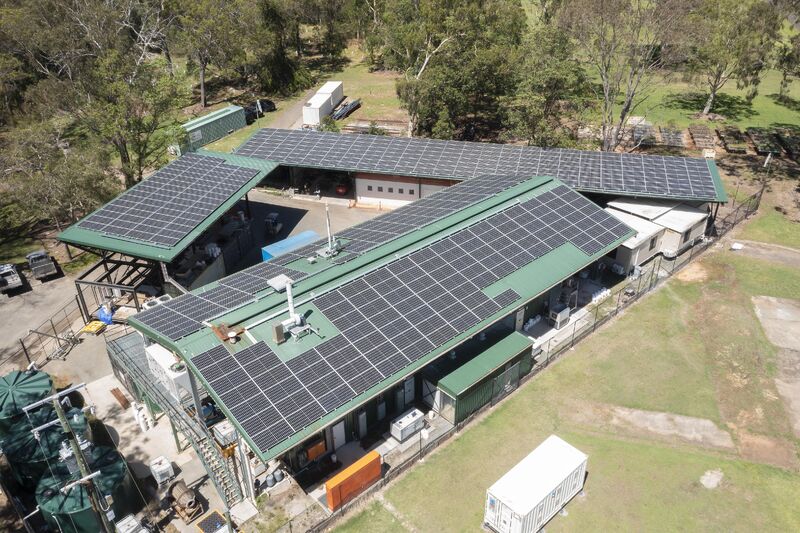

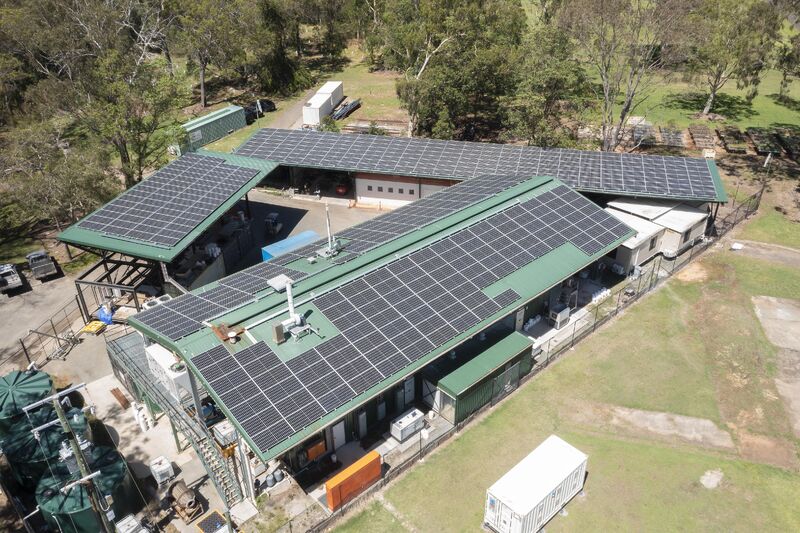
Advanced materials company Lava Blue has commissioned a 250 kW/1.45 MWh sodium-sulphur (NAS) battery energy storage system at its Centre for Predictive Research into Specialty Materials (PRiSM) facility in Brisbane’s southeast, marking the first time the technology has been connected to the National Electricity Market (NEM).
The battery, manufactured by Japan’s NGK, has been integrated with 200 kW of existing solar generation at the site and plugged into Energex’s local distribution grid.
Lava Blue said the solar and battery system can supply up to 100% of PRiSM’s peak operating load, supporting the processing of critical minerals into high-purity materials used across battery, semiconductor and advanced manufacturing supply chains.
The project was delivered through the Queensland University of Technology’s (QUT) Queensland Energy Storage Technology (QUEST) Hub, a state government-funded initiative focused on accelerating the development and commercialization of battery materials, chemistries and systems.
Lava Blue Managing Director Michael McCann said the project provides a real-world demonstration of NAS battery technology, showcasing its potential to support long-duration energy storage for powering commercial and industrial applications as well as supporting grid reliability.
“PRiSM was established to bridge the gap between laboratory research and industrial-scale materials processing, so it is an ideal environment in which to demonstrate a long-duration battery technology under genuine operating conditions,” he said.
“Our advanced materials processes include high-temperature and other energy-intensive operations. Integrating solar generation with long-duration storage gives us the ability to supply those loads with renewable energy for extended periods and better understand how advanced manufacturing can operate alongside future energy systems.”
Lithium-ion technology currently dominates the battery market but it has limits, typically offering short-duration energy storage of just two to four hours. NAS batteries are capable of discharging for six hours or more at rated capacity, making the technology suited to applications including renewable energy firming, peak demand management and grid stability.
Lava Blue said the technology has more than 20 years of commercial operating experience internationally, with approximately 5 GWh deployed across more than 250 applications.
Australia’s first NAS battery system was rolled out in 2023 as part of a microgrid at a Western Australian mining site while Queensland electricity generator CleanCo has previously announced plans to pilot the technology.
QUEST Hub Director Joshua Watts said the PRiSM installation extends that work into a grid-connected industrial setting, providing further operating experience to inform potential future deployment of NAS technology in Australia.
“The successful commissioning of Australia’s first grid-connected NAS battery energy storage system marks an important milestone,” he said. “The project has brought together researchers, industry and government to demonstrate an alternative long-duration energy storage technology under real industrial operating conditions.”
Victoria-based Allset Energy provided the electrical engineering, installation and system integration for the project, including development of the interface between the NAS battery, PRiSM’s solar generation, the facility and the grid.
Queensland manufacturer Advanced Converter Solutions (ACS) designed and supplied the bidirectional DC-DC converter platform that enabled the battery system to integrate with the project’s high-voltage DC infrastructure. More than 80% of the purpose-built control unit was manufactured using Australian content.
The post Lava Blue hosts Australia’s first grid-connected sodium-sulfur battery appeared first on Energy Storage.