


Energy storage ranks among the premier technologies for supporting renewable energy deployment and enabling grid stability as capacities increase to meet skyrocketing demand. Lithium-ion battery energy storage systems (BESS) have emerged as cost-effective and widely deployed solutions for an array of storage applications, from frequency regulation to peak shaving to interruptions in service.
Researchers caution that this market dominance has a downside in that the relatively short duration of lithium-ion storage is not necessarily most appropriate for long-duration energy storage (LDES) needs. A recent webinar hosted by the Clean Energy States Alliance, a coalition of US state energy agencies, worked to untangle some of the reasons why more appropriate technologies are not being commercialized in certain use cases.
In short, financiers have settled on the bankability of lithium-ion technology, so the fit for every storage need looks BESS-shaped.
According to Will McNamara, grid energy policy analyst at Sandia National Laboratories, LDES generally means those technologies able to provide at least 10 hours of storage duration, out to days, weeks or even months. The purpose of LDES is to be able to handle multi-day weather lulls and seasonal shifts. By contrast, medium-duration energy storage is typically eight hours to 24 hours, he said, and primarily used for daily load shifting.
The caveat is that different entities have different definitions. The U.S. Department of Energy, which funds McNamara’s research, not surprisingly supplies its definition of LDES as 10 or more hours of storage duration. At the same time, you will find industry calling technologies with as little as four hours of storage duration “long.”
“While we often refer to LDES kind of in the singular, it’s far from a singular technology,” McNamara said. “Within these definitions and these categories, we’re literally talking about hundreds of energy storage technologies that are claiming that they are able to provide this extended duration capability.”
With that said, the United States is certainly the world leader in deployed grid-scale energy storage. Citing industry sources, McNamara offered the following statistics:
- Of the 1,643 operational energy storage projects worldwide, 49% are located in the United States;
- As of July 2026, the U.S. has more than 50 GW of utility-scale BESS operating capacity;
- The US installed 9.7 GWh of BESS in the first quarter of 2026 alone, up 32% over the same period last year;
- California (60 GWh), Texas (29.2 GWh) and Arizona (20.2 GWh) are the top states in terms of utility-scale storage capacity installed; and
- Cumulative BESS operating capacity is projected to reach 200 GW/655 GWh by 2031.
“This [expansion] is driven mainly by the utility sector, which will make up about 85% of installations between 2026 and 2031,” McNamara said. “The forecast for energy storage as a general category remains very bullish.”
That said, the market is dominated by technologies, principally lithium-ion BESS, that are considered bankable if not necessarily the best fit for the application. McNamara said that while lithium-ion batteries are commercially mature and economical – and thus acceptable to project financiers – they are still limited to about four hours’ duration, which is a very generous extension of the LDES label.
At the same time, there is still room for future development. McNamara points out that the BESS-based Tumbleweed Energy Storage project in California has a duration of eight hours, providing 125 MW/1,000 MWh. Nevertheless, lithium-ion may not be the most suitable technology for LDES, and there is a lot of research and development work being done on alternative battery chemistries and architectures such as flow batteries.
McNamara points out that the total US installed capacity of LDES under its more conservative definition sits at around 16 GWh of total capacity. Perhaps surprisingly given the attention given to BESS coverage, pumped hydro storage still represents more than 90% of this capacity.
“Pumped hydro is really the ‘OG’ of LDES,” he said. “It continues to provide the bulk of multi-day gigawatt scale duration. So, we’re talking about that 10% of the LDES market that is now being developed for other technologies.”
One way to look at future storage technology trends is to evaluate electricity generation plans coming down the pike. This is because existing energy storage technologies tended to develop in tandem with the power sources they support. Jeremy Twitchell, a senior energy analyst at the Pacific Northwest National Laboratory (PNNL), says one of the issues his policy and regulatory team is studying is the near-term use cases for LDES.
“Pumped storage hydropower, still the king of long-duration energy storage, was created to help us integrate nuclear technologies,” Twitchell said. “Nuclear could not ramp up and down throughout the day, so we built pumped hydro storage to help take off that load following.”
Similarly, understanding what the near-term demands are will help identify what kinds of generation are needed and then what storage technologies will best support these. This is important, Twitchell maintains, because markets and compensation mechanisms then can be adapted to better account for the values of LDES, thus giving them a better chance of success.
“We’re not quite there yet,” he said.
A key focus of PNNL’s research is examining how pairings of different generation sources with various storage technologies produce the most efficient and cost-effective outcomes. For example, Twitchell says recent analysis shows combined-cycle natural gas generation combined with any LDES system with a round-trip efficiency (RTE) as low as 60% can still be more efficient than burning another unit of gas to follow the load.
Round-trip efficiency refers to the percentage of energy recovered from storage compared to what was put in. Sandia benchmarks show that lithium-ion batteries have the highest at 85% to 95% RTE. By comparison, flow batteries and metal-air batteries operate at 70% to 80% RTE.
“I’m better off using that long duration storage system to meet my high demand needs than I am using the peaker to meet my high demand needs,” Twitchell said.
The caveat here, he continues, is that four-hour lithium-ion BESS is the most cost-effective way of doing this now, yielding the highest returns. Eight-hour storage systems, while cost-effective, are not as cost-effective as four-hour systems. Ten-hour systems were very close to penciling out, but still: not yet.
“This analysis finds some indicators for LDES to meet this particular use case for improving the economics of base generators,” Twitchell said. “We need to see some improvements in round-trip efficiency.”

Such improvements in LDES efficiency are not just needed for the overall effectiveness of the grid infrastructure but to enable financing for the sorts of storage technologies that can support base generation over prolonged periods, such as in the face of adverse weather conditions or other long-term emergencies.
Anna Siefken, director for North American policy and markets at the Long Duration Energy Storage Council, an industry trade organization, says technology development is not really the obstacle to commercial LDES deployment. Rather, bankability is a major issue again largely because of the market dominance of lithium-ion batteries serving many storage functions.
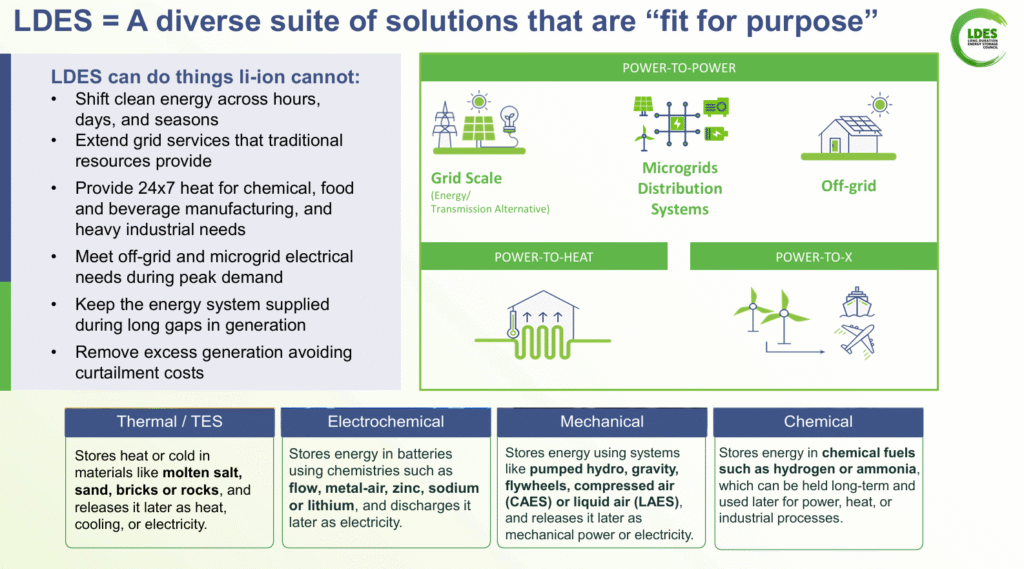
“Bankability really describes a project’s expected revenue, the risk profile and the technology performance that gives lenders and insurers the certainty that they need to make the investments,” Siefken said. “Many competing technologies; some chemical, some thermal, some mechanical; are fit for purpose. Some of them, like vanadium flow batteries, have been around for dozens of years. There are companies that have many, many deployments in other countries outside of the US.”
One challenge is communicating the information. The LDES Council publishes a number of reports for making apples-to-apples comparisons between different LDES technologies in various use cases. Ideally, such resources could help utility planners evaluate existing options they may not be aware of and financiers see examples of real-world deployments.
Another hurdle is getting governments and regulatory bodies to address policy frameworks that recognize LDES value. According to Sandia, US electricity markets and capacity mechanisms compensate utilities for short-term power delivery, not the ability to continuously serve a load for multiple days. Siefken says her organization is seeing some promising movement on the policy front.
“There’s going to be a wave of state legislative sessions that are opening in early 2027, and we’ve seen dockets that are ready to go to talk about LDES procurements and carve-outs specifically for eight hours and longer,” she said.
From pv magazine USA
The post Lithium-ion bankability may be holding back long-duration storage appeared first on Energy Storage.