
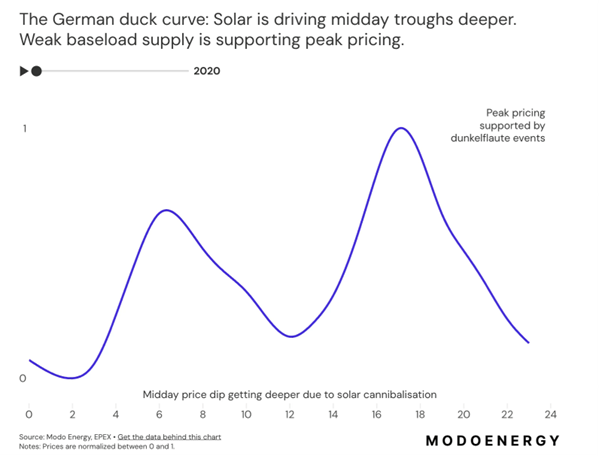

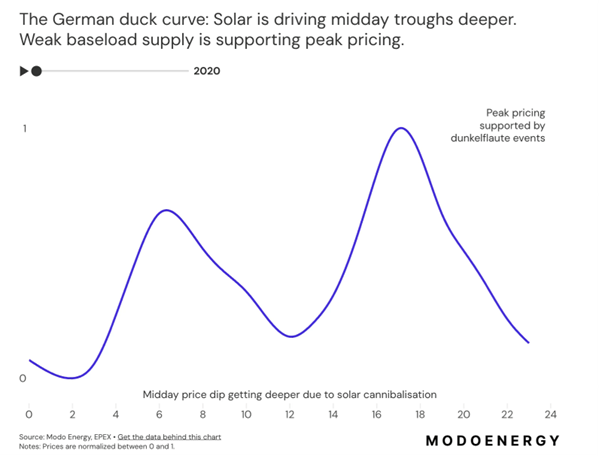
Germany needs batteries. And the same is true of German solar. As intraday price spreads grow in wholesale markets, the economics of utility-scale battery storage and solar-plus-storage hybrid projects are becoming more compelling. Deep and increasingly-frequent periods of very low or negative prices are being followed by soaring evening peaks, creating both a challenge for standalone solar and an opportunity for energy storage.
The following two charts from Modo Energy illustrate the trend. The chart on the left shows wholesale electricity prices over the course of the day in 2020, with a distinct daytime trough during peak solar generation and a pronounced evening peak – the classic “duck curve.” Fast forward to 2025 and both features have become even more pronounced.
For solar developers, that deepening midday trough puts growing pressure on capture prices. For battery energy storage systems (BESS), however, the widening intraday spread between low daytime and high evening prices represents a significant and growing opportunity.

Inherent complexity
Despite this reality, there is little that is straightforward about developing BESS in Germany, and getting a project to final investment decision (FID) can be challenging. The barriers are manifold. Germany’s electricity market is complex, with a large number of stakeholders – including four TSOs and more than 900 DSOs – and developers must navigate an array of regulations, processes, forms, and fees.
Building a robust business case for BESS adds another layer of complexity. Key considerations include whether to co-locate storage with PV, whether the battery should operate as a “Green” or “Gray” system, and what role frequency regulation markets should play in the revenue stack.
With more than 25 years of experience in the German solar market, the meteocontrol Technical Consulting team – now operating as mc Advisory – regularly works through these questions, providing the analysis needed to inform utility-scale BESS investment decisions. And as the number of BESS projects grows, it is clear that despite the complexity, battery storage is increasingly becoming an essential component of renewable energy project development in Germany.
To demonstrate how battery sizing, co-location, and operational modeling can influence BESS revenue potential, the mc Advisory team modeled a theoretical 4 MWp solar project in Germany with 4 MW export and 1 MW import constraints, paired with either a two-hour or four-hour battery system, and providing 4 MWh or 8 MWh of storage capacity, respectively.
To calculate revenues, an optimization of the electricity traded on wholesale markets – known in Germany as “direct marketing” – on the day-ahead and intraday markets was used. These revenues were combined with modeled revenues from ancillary-service provision, and an assumed floor price of just over €0.05/kWh under Germany’s Renewable Energy Sources Act or EEG.
The floor price under the EEG is relevant for solar energy, whether it is directly marketed or stored in a Green BESS at timepoints when the wholesale price isn’t negative. The model assumed that half of the available BESS power would be offered into the ancillary-services market – specifically for automatic Frequency Restoration Reserve or “aFRR up.”
The aFRR mechanism is typically triggered when there is too little generation or too much consumption and the grid frequency must be restored. To illustrate, a battery offering 2 MW of aFRR up might normally be idle or charging. If the system requests 60% activation, it could be instructed to provide approximately 1.2 MW more upward support, usually by discharging or reducing its charging by this amount. It should be noted that in the modeling exercise it was assumed that the BESS capacity kept in reserve for the aFRR up would not be accepted on all occasions, due to the dynamic and competitive nature of this market.
The results of the modeling – displayed in the accompanying chart and table – highlight several key market dynamics shaping BESS business models in Germany, including the impact of system sizing, operating strategy, and the significance of aFRR up revenues on potential earnings.
Modeled German project revenues
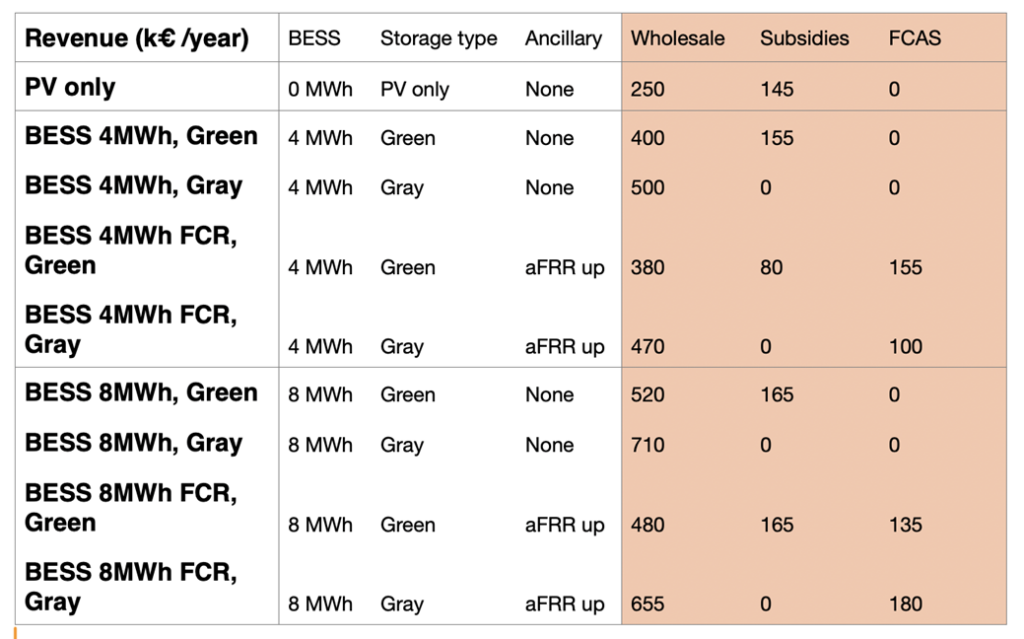
Image: mc Advisory
Advantages of co-location
The “PV only” system provides an effective base case. With annual revenues forecast at €250,000 on the spot market and €145,000 under the EEG, the ongoing importance of Germany’s subsidy program for solar installations is underscored. However, adding on-site BESS immediately increases revenue potential. Spot-market revenues rise to €400,000, while EEG revenues increase to €155,000, as the battery can charge during periods of negative pricing and discharge during higher-priced evening hours.
Beyond the revenue uplift, co-locating solar and storage offers several other advantages in Germany. Sharing infrastructure can reduce both capital and operating costs, while also enabling more efficient use of existing grid-connection points. And with lengthy permitting timelines currently a feature of the German BESS market, retrofitting battery storage to existing solar parks can also be an attractive option.
“Green” or “Gray”
Another important consideration in BESS development is whether the battery is charged exclusively from on-site solar as a Green system, or if it can also charge from the grid when Gray. While a Gray operating strategy can result in optimized arbitrage opportunities and BESS state of charge with cheap imports from the electricity grid, a Green system energy is eligible for subsidies under the German EEG. The Green battery benefits from the EEG floor pricing when discharging, as it is only charged from the adjacent solar generation. The choice depends heavily on the developer’s objectives – including whether the priority is adding renewable capacity or maximizing the profitability of energy assets – but it can also have a significant impact on revenues.
In the modeling exercise, the 4 MWh BESS increases annual revenue by approximately 40.5% compared with standalone solar when operated as a Green system, equivalent to an additional €160,000 per year. A Gray battery of the same size has access to greater arbitrage opportunities as it can charge during periods of negative wholesale pricing and manage its state of charge more effectively. On the downside, the loss of EEG revenues means the overall uplift is lower, at approximately 26.6%, or €105,000 per year.
With a bigger battery, however, the economics shift. The 8 MWh Green battery achieves a revenue boost of 73.4%, or €290,000. The 8 MWh “Gray” system can make greater use of its additional capacity to exploit wholesale market peaks and troughs, lifting the revenue increase to more than 79.7%, or €315,000 per year. At this scale, the additional arbitrage opportunity more than offsets the loss of EEG revenues.
Frequency Control Auxiliary Services (FCAS) revenues
What, then, is the role of Germany’s ancillary services markets? In Europe’s first-mover utility-scale BESS geographies, like the United Kingdom, ancillary services were a primary driver of deployment. However, these markets have proven relatively “shallow” and can become saturated quickly as cumulative battery capacity increases.
Using 2025 ancillary-services aFRR up revenues as a reference, the contribution from these markets is significant and should be of material interest to developers. The 8 MWh Gray system including aFRR up revenues, for example, generates the highest total revenue of all the configurations modeled, at €835,000 per year. In this scenario, some wholesale market revenues are cannibalized as a portion of the battery’s capacity is reserved for ancillary services. But the upside far exceeds the down.
In the 8 MWh Gray scenario including ancillary revenues, the system generates an additional €180,000 in revenues from the aFRR up mechanism – more than offsetting the foregone wholesale revenue. Similarly, the 4 MWh system generates €100,000 in additional ancillary revenue, again easily surpassing the forgone wholesale revenues.
The economics remain compelling for Green systems, although not to the same extent as Grey batteries. For the 4 MWh BESS, €155,000 in additional ancillary-service gains compared with the €95,000 foregone in revenue – despite the large wholesale and EEG revenue cannibalization. For the 8 MWh system, the aFRR up contributes €135,000 in additional revenue, while just €40,000 is lost in wholesale trading and under the EEG.
In summary, the ancillary market revenues positively influences solar-plus storage revenues – with a larger the BESS capacity yielding more from the aFRR up. The modeling reveals that while ancillary services markets cannibalize part of the direct-marketing revenue and EEG income in Green batteries, it consistently reaps three-to-four times more income than it forgoes.
Future uncertainties
How Germany’s ancillary-service markets evolve will influence BESS revenue dynamics over the lifetime of a project – some owners may be more bullish on them increasing as thermal generation continues to exit the German market. Wholesale market volatility is another important variable: larger price spreads would increase arbitrage opportunities, particularly for batteries operated as Gray systems with the flexibility to charge from the grid.
The future of EEG subsidies introduces another layer of uncertainty. Germany’s renewable energy support mechanisms have changed in the past, and developers must account for the possibility of further reforms when assessing long-term project revenues.
BESS system costs present a critical variable also. BloombergNEF reported a 27% decline in global system costs in 2025, continuing the rapid cost reductions that have strengthened the economics of battery storage. Whether declines of this magnitude can continue, however, remains uncertain.
It is also important to note that the mc Advisory analysis presented here focuses on revenue potential in the German market rather than system costs – arguably one of the most important variables in any BESS investment case. When working with developers and EPCs, the mc Advisory team incorporates detailed analysis of system costs and pricing trends as a matter of course.
There is little doubt that battery energy storage will play a profound role in the continued expansion of solar and other renewable energy technologies in Germany, across Europe, and globally. In an analysis published in August, think tank Ember concluded that the rapid deployment of BESS globally in 2026 could enable more than one-third of new solar generation installed that year to be shifted from daylight hours into the evening.
The ability to capture such a significant volume of electricity during periods of daytime oversupply and deliver it into the evening demand peak represents an important turning point in the global energy transition. It also makes it clear that BESS is here to stay. The more difficult question is how to build the optimal business case for individual projects in promising, but complex, markets such as Germany. With market conditions, regulation, technology costs, and revenue opportunities all continuing to evolve, answering that question will require ongoing and specialized analysis.
The post Building the business case for co-located BESS appeared first on Energy Storage.