


At Intersolar Europe and ees Europe in June, held in parallel at Messe München as part of The smarter E Europe, discussions were no longer dominated by module power ratings or conversion efficiency. Instead, one term surfaced repeatedly across the exhibition floor and conference sessions: flexibility.
This was more than a shift in industry vocabulary. As wind and solar penetration continues to rise across Europe and negative-price hours become more frequent, the central challenge facing the power system is shifting from how to add more renewable generation to how to deliver renewable electricity where and when it is needed. That is precisely why energy storage is taking center stage in the energy transition.
The conversation at Intersolar Europe and ees Europe echoed the key message that emerged in early June at SNEC in Shanghai, where the industry shifted its focus toward the integration of solar and storage, together with AI-driven digitalization.
The next phase of the energy transition is no longer defined by building more solar power plants, but by creating a more flexible electricity system. As China continues to expand its manufacturing capacity, that shift is likely to shape the product prices and supply dynamics of energy storage markets across the globe.
Energy storage presents a different picture. Although some leading PV manufacturers have entered the energy storage manufacturing market, capacity expansion across the storage supply chain has remained relatively disciplined. One reason is that the technology roadmap for energy storage cells has yet to fully stabilize.
Another is that the severe oversupply experienced by the PV industry has become a cautionary lesson for manufacturers across the broader clean-energy sector. As a result, the energy storage cell market has remained in tight balance overall, keeping cell prices elevated. In the near term, the storage industry is unlikely to repeat the dramatic price collapse that PV experienced over the past several years.
China’s PV policy cliff
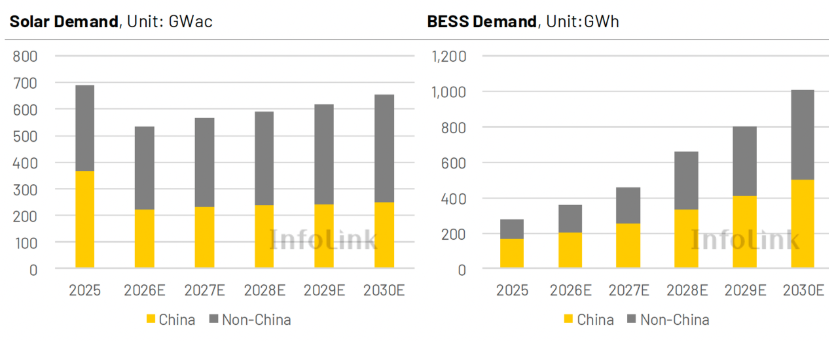
To understand this shift, we must first examine why China’s domestic PV demand is expected to fall by nearly 30% in 2026—an unusually sharp contraction. This is not a market-driven collapse in demand, but a policy-driven correction.
Following the introduction of Document No. 136, this new electricity pricing mechanism has lowered investment returns on solar projects. In some regions, wind projects now offer stronger returns than utility-scale PV, prompting developers to postpone ground-mounted solar projects. Compounding the slowdown, 2026 marks the first year of China’s 15th Five-Year Plan, with supportive policies yet to take shape.
On top of that, a rush to install ahead of policy changes in 2025, combined with adjustments to export tax rebates, pushed that year’s figures unusually high—inflating the comparison base and making the 2026 decline look steeper than it otherwise would. Together, these factors have driven the current slowdown.
InfoLink expects 2026 to mark a relative low point for China’s PV market, with demand set to recover in 2027 as the market adjusts to the new rules.
InfoLink expects energy storage demand outside China to jump by nearly 50% in 2026, exceeding 150 GWh, with most of the batteries required to meet that demand supplied by China. In other words, Chinese manufacturing will remain the engine behind global energy storage supply.
Storage gains momentum
The shift was clearly visible on the exhibition floor. Based on InfoLink’s on-site observations, several leading manufacturers had smaller booths than last year. Yet discussions around energy storage continued to gain momentum. Whether at PV booths or ESS booths, storage was the leading buzzword on the floor—a contrast that is itself a microcosm of the industry’s shifting center of gravity.
Even more noteworthy was the shift in product strategy. In previous years, the focus in Europe’s utility-scale storage market was largely on maximizing system capacity. This year, however, much of the discussion centered on market solutions and regulatory compliance.
At the system level, the product strategy has evolved from simply increasing capacity to expanding capacity while also meeting weight limits and regulatory requirements. Ten-foot battery containers have emerged as a key focus for leading suppliers, with manufacturers competing to maximize density within transport compliance thresholds.
What may appear to be a technical detail actually points to a broader change in the market. The next wave of products entering Europe will not be defined by lower cost cells, but by fully integrated storage systems designed to meet local application needs, regulatory requirements, and grid connection standards.
InfoLink expects Europe’s energy storage capacity additions to reach about 44.3 GWh in 2026, representing year-on-year growth of more than 60%. Growth is broadening across the region. Beyond the established leading markets, Bulgaria, the Netherlands, Spain, Poland, and Romania are also expected to expand rapidly.
Freight costs rise
InfoLink’s weekly supply chain price tracking shows that weaker PV demand in China will not translate into cheaper battery cells for European buyers. Battery-grade lithium carbonate prices have rebounded from around CNY 60,000 ($8,865)/MT in mid-2025 to roughly CNY 150,000/MT to CNY 160,000/MT by mid-2026, pushing Chinese cell prices higher since the first quarter.
Prices for 280 Ah and 314 Ah cells have risen from CNY 0.29/Wh to CNY 0.30/Wh to CNY 0.36/Wh to CNY 0.37/Wh, including tax. InfoLink expects cell prices outside China to remain elevated in the second half of 2026 and potentially edge higher, supported by lithium carbonate costs.
The picture is different at the system level. Project returns continue to constrain pricing, meaning system prices have not risen as quickly as cell prices. According to InfoLink’s one-year forecast, the average price of a four-hour AC-side energy storage system (ESS) in Europe is expected to ease gradually from around $113/kWh in mid-2026 to about $108/kWh by the end of the year. The divergence between firm cell prices and gradually declining system prices will be one of the key trends shaping project economics.
Developers should also pay close attention to a less visible cost. Shipping costs for ESS from China to Europe have increased significantly this year because of higher freight rates and longer shipping routes. Based on deliveries to the Port of Rotterdam, port-to-port logistics costs for a 5 MWh, two-hour DC-side battery container have risen from about $1.1/kWh to $1.4/kWh at the end of 2025 to around $1.5/kWh to $1.9/kWh in June 2026.
For project developers, cell price trends alone are no longer enough to determine the total installed cost of a storage project.
Focus on flexibility
Looking ahead to 2027, the release of new cell capacity and lower lithium carbonate costs are expected to gradually ease energy storage system prices, rather than trigger another sharp price collapse.
For Europe, the key to winning this race is no longer whether prices will fall further, but how well it can read the pace of change. That means understanding how China’s PV oversupply will gradually rebalance, how long the battery cell market will remain in tight supply demand balance, how new system designs and capacity will reshape project economics, and how the growing emphasis on integrated PV-plus-storage solutions and regulatory compliance will affect project costs.
Taken together, these developments bring us back to the keyword running through the industry: flexibility. Across much of Europe, standalone solar projects have become difficult to justify on economic grounds. Adding battery storage, however, can fundamentally change the equation, turning projects with unattractive returns into bankable investments.
China’s policy decisions and manufacturers’ strategies will remain closely tied to the global renewable energy market, directly influencing prices, supply, and demand across the solar and energy storage value chain. InfoLink reads this pace from within the supply chain, offering an early view of emerging trends before they are fully reflected in the market.
2025-2030E Solar PV and BESS Demand Forecast

Source: InfoLink PV Supply and Demand Database, Global Energy Storage Supply Chain Database
InfoLink Insight|August 2026
- Battery price trend:
Supported by lithium carbonate costs, energy storage cell prices outside China are expected to remain elevated in the second half of 2026, with 314 Ah cells priced at around USD 50–53/kWh. System prices, on the other hand, remain constrained by project economics, with the average price of a four-hour AC-side ESS in Europe expected to ease gradually to about USD 108/kWh by year-end. Meanwhile, ocean freight costs from China to Europe have been rising in tandem and warrant close tracking.
- Supply-chain observation:
Global energy storage cell manufacturing capacity is expected to increase from nearly 800 GWh in 2025 to more than 1,000 GWh in 2026. Full-year cell shipments could reach 900 GWh, representing year-on-year growth of around 50%, with the supply chain expected to remain in a tight balance.
- ESS Demand forecast:
Europe’s energy storage capacity additions are expected to reach around 44.3 GWh in 2026, representing year-on-year growth of more than 60%. Utility-scale and C&I storage are projected to maintain strong growth, while residential storage is expected to return to growth after last year’s downturn.
- Exhibition takeaways:
At Intersolar Europe 2026, the exhibition mix showed a clear tilt toward energy storage, with most PV manufacturers also showcasing storage solutions. In the utility-scale segment, product strategies shifted from capacity expansion alone to balancing capacity gains with transport weight limits and regulatory compliance: ten-foot battery containers attracted growing attention from leading suppliers. Among energy storage cells, 587 Ah and 588 Ah cells remained popular large-format models on display, while interest in 684 Ah cells picked up again.
Note: Price data are as of early July
Source: InfoLink’s weekly price tracking
Corrine Lin brings over a decade of expertise in renewable-energy research and market intelligence, spanning solar, energy storage, and the net-zero transition. As InfoLink’s chief analyst since its founding, Lin has led the team in delivering actionable industry insights. Since assuming the role of chief executive officer of InfoLink Consulting in January 2026, she has continued to advance the company’s research-driven strategy and advisory capabilities.
The post Flexibility shapes Europe’s storage future: Signals from China’s supply chain appeared first on Energy Storage.