


The recent approval by the German Federal Cabinet to abolish feed-in tariffs for newly installed photovoltaic systems up to 25 kW from 1 January 2027 marks another significant shift in Europe’s distributed energy landscape. The reform follows the already confirmed phase-out of net metering in the Netherlands from the same date, further strengthening the economic case for behind-the-meter energy storage.
Combined with expanding opportunities from dynamic electricity tariffs and revenue stacking strategies, these policy developments are increasingly encouraging consumers and businesses to maximize on-site energy utilization rather than export excess generation to the grid (for further insights on revenue stacking opportunities, see our previous analysis here). At the same time, these developments add to the renewed focus on energy resilience and security across Europe following recent geopolitical tensions (read our previous analysis here).
Together, these structural market shifts are accelerating storage adoption across residential, commercial & industrial (C&I), and utility-scale segments, creating a market that is becoming increasingly dynamic, segmented, and strategically important for manufacturers.
Navigating Europe’s increasingly segmented storage market
The accelerating growth of energy storage is not occurring uniformly across Europe. While residential markets continue to benefit from evolving self-consumption economics, Commercial & Industrial (C&I) and utility-scale deployments are increasingly being driven by grid flexibility, energy cost optimization, and large-scale decarbonization strategies. Moreover, the pace of development varies considerably by country, with policy reforms, electricity market structures, and investment conditions creating distinct growth trajectories across market segments. As these dynamics continue to evolve through 2027 and 2028, manufacturers can no longer rely on broad regional assumptions or isolated market indicators. Instead, understanding segment-specific developments, country-level outlooks, and the underlying policy and economic drivers is becoming increasingly important for strategic market prioritization and roadmap planning.
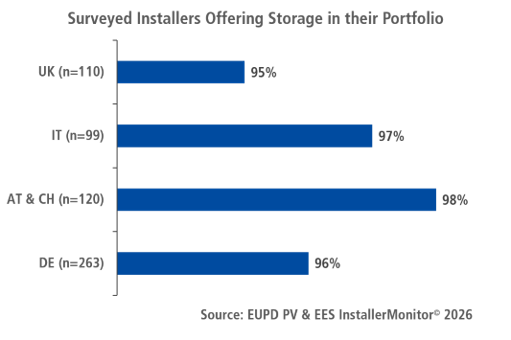
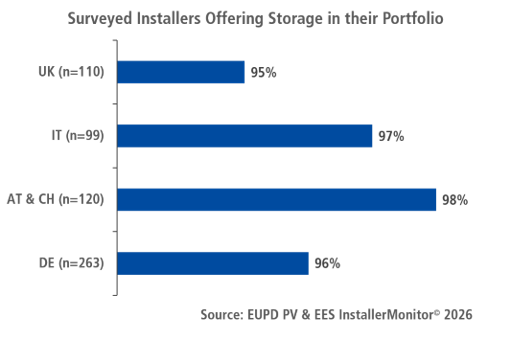
This trend is already reflected in Europe’s installer landscape. According to the latest EUPD PV & EES InstallerMonitor surveys, more than 95% of installers across Germany, Austria & Switzerland, Italy, and the United Kingdom already offer storage solutions within their portfolios. As storage becomes a standard component of downstream offerings, understanding how individual markets and segments are evolving is becoming ever more important for manufacturers planning their European strategy.
These downstream developments further reinforce the need for a structured understanding of how individual storage markets are evolving across Europe.
A holistic view of Europe’s evolving storage market
To support strategic market planning, EUPD Research is releasing the latest iteration of the Electrical Energy Storage Report Europe H1 2026, providing a biannual assessment of Europe’s residential, Commercial & Industrial (C&I), and utility-scale storage markets. Beyond installation forecasts, the report combines detailed country deep dives covering market size, growth drivers and barriers, policy and regulatory developments, revenue opportunities, investment risks, and forward-looking market outlooks, enabling manufacturers to prioritize markets based on a comprehensive understanding of their underlying fundamentals rather than individual market indicators alone.
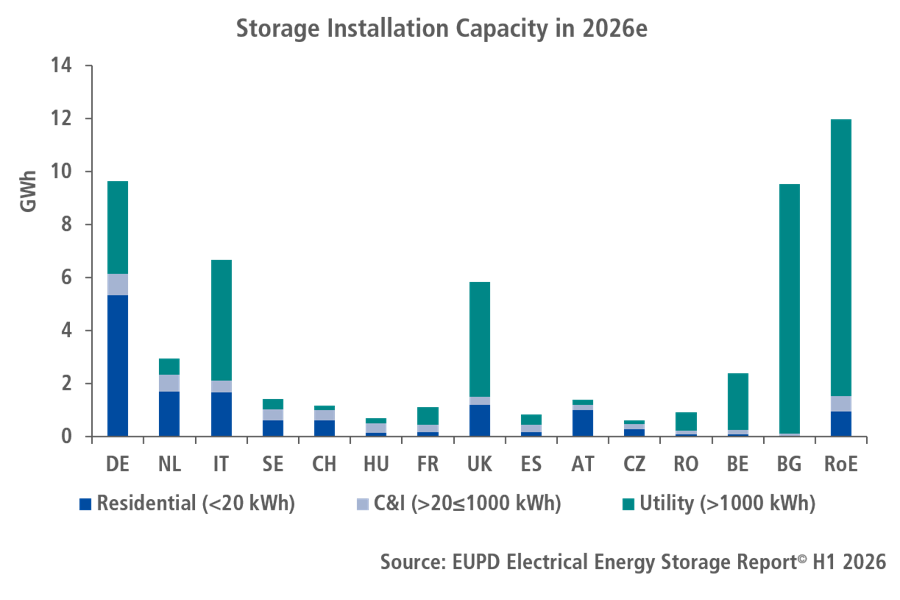
The latest analysis highlights the diversity of Europe’s storage landscape. In the residential segment, Germany is expected to remain Europe’s largest market, accounting for almost half of Europe’s one million new home storage systems installed during 2026. This trend will certainly accelerate from next year onward, driven in part by the changes to the feed-in tariff. Additionally, the Netherlands is forecast to experience particularly strong momentum ahead of the planned net-metering phase-out in 2027.
At the same time, growth in the C&I segment is accelerating across markets such as Germany, the Netherlands, Italy, and Sweden, driven by increasing opportunities for energy optimization and flexibility services. Utility-scale deployment is also gaining momentum across Europe, with the United Kingdom supported by its Clean Power 2030 Action Plan and one of Europe’s strongest battery project pipelines, while Bulgaria is rapidly emerging as a key regional flexibility market through substantial EU-funded storage programs and a growing pipeline of large-scale projects. Looking beyond 2026, these trends are expected to continue reshaping market priorities across Europe through 2027 and 2028, further emphasizing why continuous market intelligence has become essential for manufacturers operating across Europe’s evolving storage landscape.
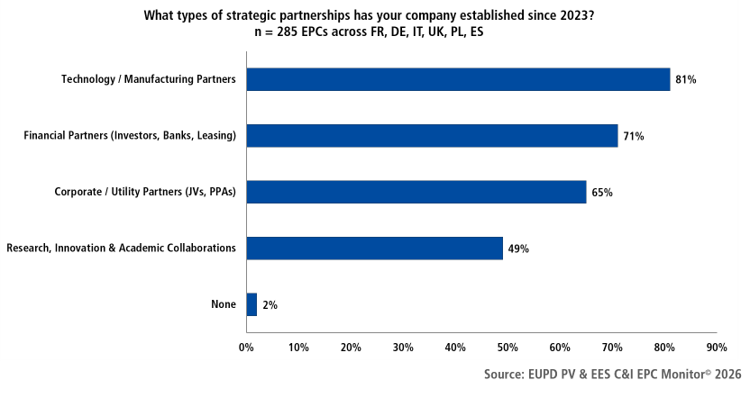
Beyond country-level market dynamics, understanding downstream channel evolution has also become significantly important. Findings from the latest EUPD C&I EPCMonitor show that technology and manufacturing partnerships have become the most common strategic collaborations established by European EPCs since 2023, reported by 81% of surveyed companies. Financial partnerships (71%) and corporate or utility collaborations (65%) also rank highly, highlighting how successful project delivery depends on integrated ecosystems rather than standalone hardware. For manufacturers, this reinforces the growing importance of long-term downstream partnerships alongside product competitiveness as Europe’s storage market continues to mature.
Understanding Europe’s Residential Storage Market Leaders
In addition to comprehensive market intelligence, the Electrical Energy Storage Report Europe H1 2026 also presents EUPD Research’s latest assessment of market shares among residential energy storage manufacturers across Europe. The analysis is based on a proprietary methodology that combines multiple independent data sources, including installation data from Germany’s Marktstammdatenregister (MaStR), proprietary insights from the EUPD PV & EES InstallerMonitor, EUPD C&I EPCMonitor, and EUPD Solar ProsumerMonitor, together with manufacturer sales data shared directly with EUPD Research for validation and cross-referencing. By integrating downstream purchasing behavior, installed base analysis, and manufacturer-reported sales, the methodology provides a robust assessment of competitive positioning across the European residential storage market.
The latest findings identify Fox ESS, Pylontech, and BYD among the Top 5 residential energy storage manufacturers in Europe in H1 2026. While these rankings provide a benchmark of competitive positioning within the European residential storage market, they represent only one dimension of overall market performance.
Beyond Market Share: Measuring Long-Term Brand Performance
Competitive positioning, however, is determined by more than installation volumes alone. As project requirements become increasingly sophisticated and procurement decisions extend beyond technical specifications and pricing, factors such as installer and EPC trust, long-term product support, financial resilience, ESG transparency, and innovation capability are becoming progressively important in supplier selection. Recognizing this, the EUPD Brand Trust & Performance Rating© (BTPR) provides a holistic framework to evaluate manufacturers across three dimensions:
- Downstream Trust – reflecting installer, EPC, and prosumer perception, recommendation, product quality, and service support.
- ESG Transparency & Innovation – assessing manufacturers’ commitment to sustainability, product innovation, and technological leadership.
- Price Performance & Financial Stability – evaluating long-term competitiveness, value proposition, and confidence in the manufacturer’s ability to support customers throughout the product lifecycle.
The latest BTPR assessment for the European storage market recognizes BYD, SolaX Power, and Pylontech with an AA+ Rating, demonstrating strong performance across all three pillars. Together with the market share analysis presented in the new EES Report, the framework provides manufacturers with a broader understanding of both current market leadership and the factors influencing long-term competitiveness in Europe’s evolving storage sector.
Moreover, these leading manufacturers are also differentiating themselves by enabling customers to maximize the value of their storage investments through intelligent energy management, greater operational flexibility, and new revenue opportunities. These evolving market requirements are also reflected in the latest generation of storage technologies entering the European market.
Innovation is redefining the value of energy storage
The latest EUPD Top Innovation Award awardees further illustrate how Europe’s storage market is evolving beyond conventional battery systems. Rather than focusing solely on storage capacity or hardware performance, manufacturers are increasingly developing intelligent energy platforms that combine AI-driven energy management, system integration, operational flexibility, and enhanced safety to maximize the value of stored energy. These developments closely reflect the broader market trends discussed throughout this article, where revenue optimization, intelligent energy management, and integrated storage solutions are becoming key differentiators across both residential and commercial applications.
Recent TIA-recognized innovations provide concrete examples of how manufacturers are responding to these evolving market requirements. Fox ESS’s T-MAX Plus integrates PV generation, battery storage, EV fast charging, backup power, and energy management into a single DC-coupled commercial platform, maximizing self-consumption, operational flexibility, and energy arbitrage opportunities. LONGi’s HI-MO One Pro combines intelligent Cell-to-System (iCCS) technology with predictive safety monitoring and high-efficiency solar-storage integration to improve reliability, efficiency, and long-term system performance. Meanwhile, SolaX Power’s XMATRIX AI Solutions applies artificial intelligence throughout the energy management lifecycle, enabling predictive battery management, dynamic tariff optimization, advanced diagnostics, and intelligent scheduling to transform storage systems into self-optimizing energy assets. Together, these innovations demonstrate how Europe’s storage market is rewarding manufacturers that combine intelligent software, integrated system architectures, and customer-centric value creation to strengthen both product differentiation and long-term market competitiveness.
Conclusion: Navigating Europe’s next phase of storage growth
Europe’s energy storage market is strongly being shaped by evolving policy frameworks, changing electricity market economics, energy security considerations, and continuous technological innovation. At the same time, storage applications are becoming more diverse across residential, commercial & industrial, and utility-scale segments, each presenting distinct opportunities, competitive dynamics, and investment priorities.
For manufacturers, succeeding in this environment requires more than responding to individual market developments. It demands a comprehensive understanding of where demand is emerging, how market leadership and downstream ecosystems are evolving, what installers and EPCs value most, and which innovations are shaping the next generation of energy storage solutions. Market intelligence, competitive benchmarking, downstream trust, and continuous innovation are no longer independent considerations, but complementary elements of long-term strategic success.
As Europe’s storage market continues to mature, manufacturers that combine data-driven market prioritization with strong downstream trust, technological leadership, and differentiated value creation will be best positioned to strengthen their competitive position and capture the opportunities created by the continent’s accelerating energy transition.
Authors: Saif Islam and Varun Mahankali
Saif Islam is a Senior Consultant at EUPD Research, contributing to the organization’s mission of delivering high-quality market intelligence, strategic insights, and industry research across the global renewable energy and sustainability sectors. With 12 years of experience in energy market analyses, and sustainability-driven strategy, he supports stakeholders in understanding market dynamics, emerging technologies, and evolving policy landscapes. He can be reached at s.islam@eupd-research.com.
Varun Mahankali is a Senior Consultant and the Manager of the Top Innovation Awards at EUPD Research. He has over five years of experience in clean tech research and consulting. His expertise spans market intelligence, innovation analysis and consulting within the renewable energy sector. He can be reached at v.mahankali@eupd-research.com.
The views and opinions expressed in this article are the author’s own, and do not necessarily reflect those held by pv magazine Group.
The post Market intelligence, innovation, and trust: The manufacturer’s new playbook for staying ahead in Europe’s storage market appeared first on Energy Storage.