



This article is brought to you by CoolIT, an Ecolab Company.
Beyond 250 kW a server rack can no longer be cooled by a hybrid approach of liquid and air. At this density a 70/30 liquid-air split leaves 75 kW of air load. The air cooling system needed to move it brings cost and complexity few operators will accept. The answer is near-total heat capture. Liquid takes effectively all the heat, air falls below 1 percent of the load, allowing the server to run fanless.
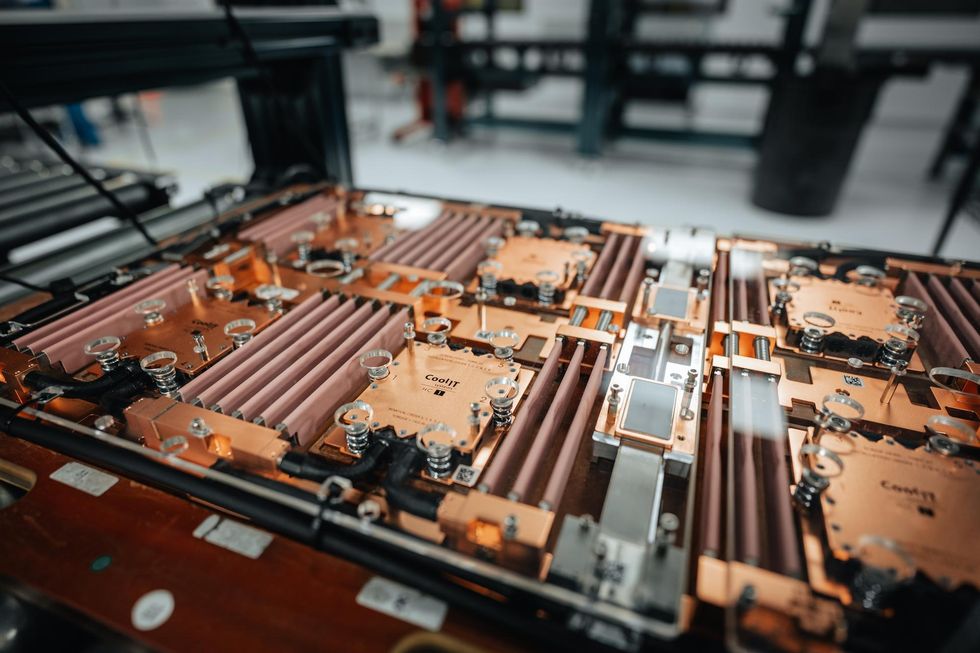
CoolIT builds these loops today from modular coldplate blocks proven across six generations of fanless designs. Processor thermal design power (TDP) keeps climbing generation over generation. This rising heat load is now cascading into the memory, networking, storage, and power components that once ran comfortably on air.
The heat escaped the chip
For years the story stayed simple. Cool the processor and let air handle the rest. That balance has shifted. As TDP climbs, heat spreads outward from the processor and cascades into the components around it. Memory, networking, storage, and power now run hot enough to demand liquid of their own. Engineers designing the next generation of AI servers face a board where heat capture rises with every launch.
Beyond 250 kW per rack, air cooling becomes the bottleneck. Near-total liquid heat capture enables fanless AI server designs built for the next generation of computing.
New parts, new rules
Unlike processors, which are cooled as flat rectangular packages, these peripherals come in a wide range of shapes, sizes, and mounting requirements, each with its own thermal limits. Some run cooler than the processor case temperature, others run hotter, which leaves them sensitive to a design tuned only for CPUs and GPUs. Operators need purpose-built solutions here, matched to the part rather than stretched across the board.
CoolIT engineers meet this with a deep toolkit. Conductive plates, vapor chambers, heat pipes, and thermal transfer plates move heat from components closer to the liquid path. Riding coldplates enable pluggable components. Each solution stays true to the component it serves.
CoolIT Customer Showcase: How GWDG Cools HPC & AI Systems with CoolIT’s Direct Liquid Cooling CoolIT
One loop, one server
Cooling the parts is one challenge. Uniting them is the real work. Full heat capture means folding every one of these solutions into a single server loop that distributes coolant effectively and remains easy to install. Connection reliability, coolant routing, and the time it takes to assemble the loop at rack integration determine whether a design thrives in production or stalls on the bench. CoolIT builds these loops from proven modular blocks, so operators gain performance and deployment speed within the same solution.
Density forces the decision
Rack power continues to climb toward 1 MW, and the case for liquid grows stronger at every step. A 70/30 split of liquid to air holds comfortably at lower density. Past roughly 250 kW it stops working. The 30 percent left to air becomes a 75 kW load inside a single rack, and moving that much heat demands a parallel air system whose cost and footprint few operators will accept. Adding density only widens the gap.
As rack power continues to climb toward 1 MW, CoolIT’s modeling places full heat capture as the standard server design for flagship rack-scale products through 2028.
The simpler, more efficient answer is to capture the heat in liquid and drop air to less than 1 percent of the total load. True 100 percent remains almost impossible to reach in the strictest sense, so the honest and achievable target is near-total capture. That distinction matters to engineers who value precision, and the direction stays clear either way. Full heat capture moves from a premium option to a mainstream requirement as density rises, and CoolIT’s modeling places it as the standard server design for flagship rack-scale products through 2028.
CoolIT delivers it
CoolIT scales heat capture all the way to 100 percent using modular coldplate building blocks proven across six generations of fanless server designs. Engineering teams are already working on designs for the maximum density racks coming next. As the cascade spreads and racks grow denser, near-total heat capture becomes the design that keeps AI running.
Talk to CoolIT about building a server loop engineered for total heat capture.