

New data released by SEIA indicates that deployments of solar and battery storage saved Texans approximately $3.55 billion and Californians approximately $2.5 billion in energy costs between June and August 2026, compared to the same period in 2021.
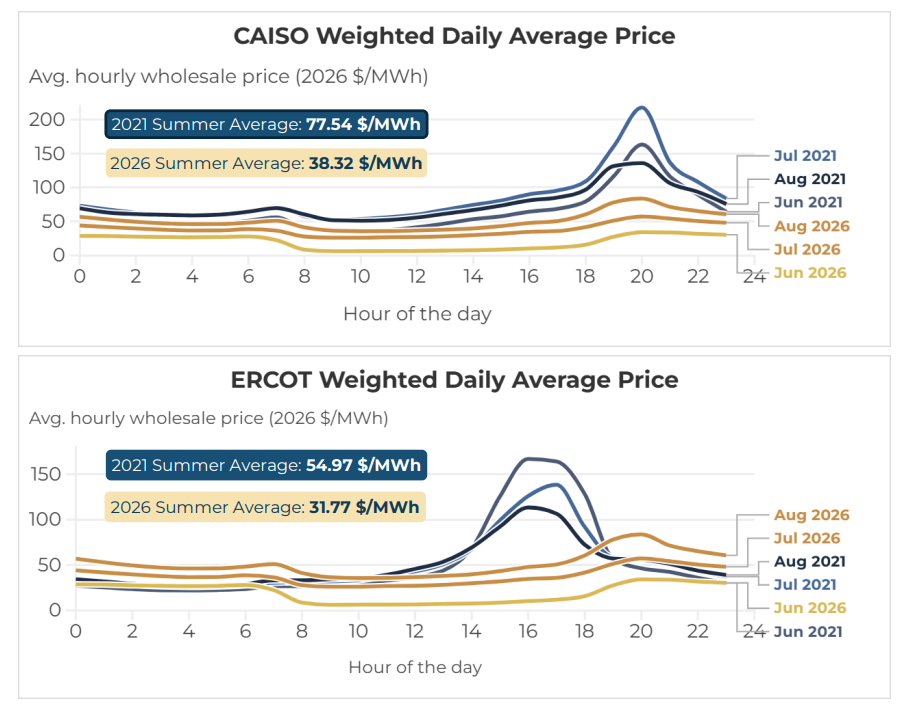
The report compared weighted average hourly day-ahead wholesale electricity prices in the Electric Reliability Council of Texas (ERCOT) and the California Independent System Operator (CAISO) markets, adjusted for inflation to 2026 dollars. Despite substantial increases in electricity demand, average wholesale prices fell sharply in both markets as solar generation and battery storage capacity expanded.
Solar generation scaled dramatically from 2021 to 2026, increasing 421% in Texas and 90% in California. Over the same timeframe, battery storage capacity expanded more than 26-fold in Texas to 33.1 GWh and nearly sevenfold in California to 62.0 GWh installed through the first half of 2026.
The impact across both grid operators highlights how clean assets displaced expensive peaker generation during peak demand hours. In the CAISO market, power consumption rose 2.5% from June through August 2021 levels, yet the average wholesale electricity price fell 51% from $77.54/MWh down to $38.32/MWh.

Peak hourly wholesale prices dropped from $141.75/MWh in 2021 to $59.69/MWh in 2026, with batteries now providing 6% to 7% of daily energy use. In the ERCOT market, total load increased 30.1% compared to the summer of 2021, while the average wholesale price dropped 42% from $54.97/MWh down to $31.77/MWh.
Peak hourly wholesale prices in Texas declined from $110.96/MWh to $57.30/MWh, with storage supplying over 1.3% of the state’s energy. Rooftop solar also expanded significantly, with generation climbing 172% in Texas to 1,533 GWh and 107% in California to 7,997 GWh.
SEIA’s findings show that the proliferation of solar and storage fundamentally alters grid dynamics by shifting the hours where high cost peaker plants set market-clearing prices. Rather than operating merely as supplemental resources, solar and battery fleets actively flatten the net load curve during late afternoon and early evening ramps. This operational shift demonstrates that high penetration renewables successfully mitigate price spikes during extreme summer heatwaves.
Grid operators observed that solar and battery assets significantly expanded the number of hours where they displaced expensive fossil peaker generation and directly set market-clearing prices. As these clean assets absorbed midday overgeneration and discharged during evening peaks, the duration of extreme price spikes contracted sharply.
However, SEIA cautions that wholesale generation savings do not translate uniformly to lowering residential electricity bills.
While wholesale generation costs dropped and residential generation portions of utility bills fell 10% in California and 4% in Texas, overall retail customer bills faced upward pressure from rising utility company transmission and distribution expenses. In California, transmission costs rose 12%, distribution costs climbed 51%, and other costs like wildfire management overhead rose 90%, while Texas transmission and distribution costs increased 17% and 23%, respectively.

Industry leadership emphasized the broader economic and political significance of the cost-mitigating impact of renewables as power demand surges.
“As the midterm elections approach, delivering affordable, reliable power is a priority that transcends party lines and Texas and California are proof that the growth of solar and storage is driving down prices,” stated Tim Pawlenty, chief executive officer and president of SEIA.
From pv magazine USA
The post Storage helps cut summer wholesale costs by billions in Texas, California appeared first on Energy Storage.