

2026 marks a breakout year for India’s energy storage market. According to InfoLink’s Emerging Market Energy Storage Demand Database, India’s annual energy storage capacity additions are expected to exceed 10 GWh in 2026—more than the cumulative total installed in all previous years—with cumulative tender volumes surpassing 100 GWh. From the deserts of Rajasthan to the coast of Gujarat, energy storage facilities are being deployed at an unprecedented pace.
A closer look inside the containers at these new facilities, however, reveals a gap between deployment growth and domestic manufacturing: core components, particularly battery cells, are manufactured almost entirely outside India.
The gap between ambition and reality
The Indian government had already anticipated the need for domestic battery manufacturing. In 2021, it launched an INR 181 billion production-linked incentive (PLI) scheme aimed at establishing 50 GWh of domestic advanced chemistry cell (ACC) manufacturing capacity. Five years later, however, progress remains limited: as of mid-2026, no more than 3 GWh of cell manufacturing capacity had entered operation—less than one-tenth of the target.
Meanwhile, policy support is accelerating growth in market demand. Under the third phase of the Green Energy Corridor (GEC-III) program, the Indian government has earmarked INR 500 billion (approximately USD 5.2 billion) specifically to deploy 50 GWh of battery energy storage systems (BESS) to support integration of renewable energy into the grid, with implementation extending through fiscal year 2032–33. In September 2026, the Central Electricity Authority (CEA) went a step further, issuing a draft proposal that would require new solar and wind projects commissioned after July 2027 to include energy storage. As policy-driven demand rises sharply and domestic manufacturing capacity ramps up slowly, the gap between the two continues to widen.
Draft Central Electricity Authority (Technical Standards for Construction of Electric Plants and Electric Lines) 2nd Amendment, Regulations, 2026
- Status: Draft issued for public and stakeholder consultation. The comment deadline was extended from October 4 to October 15, 2026.
- Background: India curtailed 8,133 GWh of solar electricity in April–June 2026, the first quarter of FY2026–27, because the grid could not absorb surplus solar output. This midday surplus, coupled with an evening power shortfall, highlights a structural mismatch between electricity supply and demand.
- Proposed requirements:
- Storage power capacity: Ground-mounted solar and onshore wind plants commissioned after July 1, 2027, would need co-located energy storage with a power capacity equivalent to at least 10% of the plant’s installed capacity.
- Storage duration: A minimum of two hours would apply initially, requiring at least 10 MW/20 MWh for a 100 MW plant. For ground-mounted solar and onshore wind plants commissioned after July 1, 2029, and through June 30, 2031, the minimum duration would rise to four hours, requiring at least 10 MW/40 MWh.
- Grid-forming requirements: Renewable energy plants commissioned after July 1, 2027, would need to have at least 15% of their inverters equipped with grid-forming control. All BESS power conversion systems (PCS) would also require grid-forming control.
Closing the gaps on multiple fronts
To address these challenges, India is pursuing a coordinated effort across the entire supply chain, with three main strands emerging.
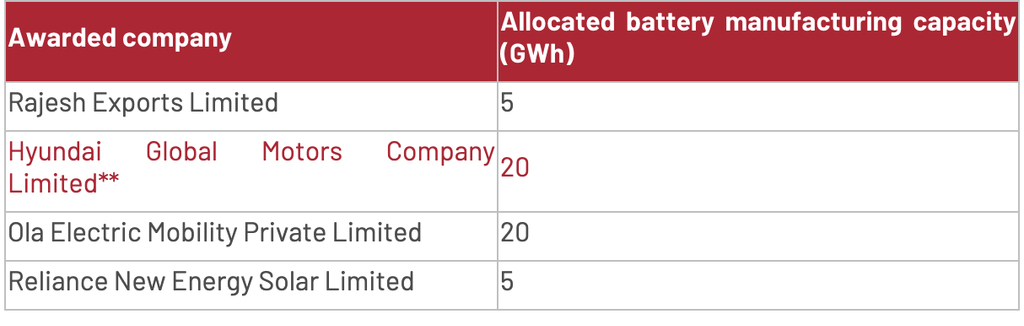
The first strand is to recalibrate the PLI scheme itself. With awarded companies facing hurdles in equipment imports, access to technology, and domestic value addition (DVA) requirements, the government has issued notices imposing daily penalties* equivalent to 0.1% of the performance bank guarantee, while also having to acknowledge practical constraints. In August 2026, the Ministry of Heavy Industries (MHI) approved revised implementation timelines for Ola’s first-round 20 GWh allocation and Reliance’s first-round 5 GWh allocation, extending their incentive eligibility period to 2031. More notably, the MHI launched a global tender for the remaining 10 GWh of cell manufacturing capacity under the PLI scheme in July, earmarked entirely for grid-scale stationary energy storage applications rather than electric vehicle (EV) applications, with bids now due on November 10, extended from October 13. This shift in emphasis suggests that New Delhi recognizes the distinct needs of stationary storage and electric vehicle batteries, and the need for a dedicated strategy.
Note: *Following MHI’s approval of revised timelines under the PLI scheme, the penalties mentioned above may be waived. However, no document explicitly disclosing such a waiver has been made public to date.
Note: Companies awarded capacity under the PLI scheme are listed below.
First-round awards (agreements signed in July 2022, except for Hyundai Global Motors)

**Hyundai Motor Group clarified that Hyundai Global Motors Company Limited had no affiliation with the group. Following concerns over Hyundai Global Motors’ eligibility, the government held off on signing the agreement, and the company subsequently withdrew from the scheme, leaving its 20 GWh allocation available for reallocation. In January 2024, the government re-tendered 10 GWh of this capacity. Reliance was awarded 10 GWh, and the other 10 GWh was earmarked for grid-scale stationary storage applications and put out to global tender in July 2026.
Cumulative allocations following the second round (agreement signed in February 2025)

The second strand is to close gaps upstream in the supply chain. Material-related constraints lie at the root of the difficulties in cell production. The government is developing an incentive scheme worth approximately INR 130 billion (USD 1.37 billion) for advanced battery cell components, extending support beyond cells to five key inputs: cathode materials, anode materials, electrolytes, separators, and copper foil. The proposal is set to be submitted to the Ministry of Finance’s Expenditure Finance Committee for review. The MHI is also assessing a battery component certification framework similar to the Approved List of Models and Manufacturers (ALMM) for solar products. Having used that list to support its domestic solar module industry, India now appears intent on replicating the approach.
The third strand is to use market demand to drive localization. Under the Viability Gap Funding (VGF) scheme supported by the Power System Development Fund (PSDF), the government requires a minimum local content of 20% of the total project cost, directing subsidized projects toward domestic procurement to support the emerging local supply chain. At this threshold, imported cells combined with local pack assembly could meet the requirement, depending on the actual share of domestic value added. Manufacturers should recognize, however, that this threshold is only a starting point. New Delhi’s apparent policy direction is to use imports and local assembly as a transitional model, gradually bringing battery and system manufacturing onshore. (The solar sector offers a precedent: local content requirements for energy storage could become progressively stricter.)*
A race against time
The central challenge in localizing India’s energy storage supply chain is a timing mismatch. The proposed storage mandate would apply from July 2027, driving additional annual demand for cells into the tens of GWh, while large-scale domestic manufacturing capacity is not expected to come online until 2028 at the earliest. Bridging this gap would require either relying on imports, which runs counter to the “Self-Reliant India” (Atmanirbhar Bharat) strategy, or imposing stricter local content requirements, which could raise energy storage costs and slow a market that is only beginning to scale up.
The outcome of this race will determine how profits are distributed across India’s energy storage supply chain and test a broader question: with the global battery industry’s structure now firmly established, can latecomers still build a supply chain of their own through sheer policy determination?
India’s market has gained momentum, but where the batteries will come from remains an open question.
Robin Song – Senior Energy Storage Analyst
As a Senior Analyst in the Energy Storage Department, Robin Song leverages prior experience at a leading lithium battery enterprise, where he was involved in lithium battery market analysis and industrial investment.
Since joining InfoLink Consulting, Robin has focused on supply-demand analysis across the lithium battery supply chain and trend forecasting in the energy storage market. He maintains close connections with major players across the energy storage value chain, providing industry insights supported by direct engagement with major stakeholders.

The post Where are the batteries? Localization concerns amid India’s energy storage boom appeared first on Energy Storage.